


What is NIBIN?
When a firearm is used, it leaves a unique mark on the bullet casing – essentially a "fingerprint." ATF's National Integrated Ballistic Information Network (NIBIN) uses the "fingerprints" to connect the casings found at a crime scene to the firearms used in the crime, which can lead to the identification of suspects.
Since the 1990s, ATF has worked with our law enforcement partners to share this ballistic intelligence across the United States, making law enforcement resources more effective. As the only national program of its kind, ATF's NIBIN is crucial in the fight against violent crime.
Why It Matters
- Speeding Up Investigations – Prior to NIBIN, firearms examiners manually inspected each casing in a labor-intensive process, which could take months. NIBIN’s automated process can produce results in just hours or days.
- Assisting ATF's Law Enforcement Partners – Evidence entered into NIBIN can link ballistic evidence from different cities or states together, enabling an efficient and effective way of investigating and closing cases that had not been possible previously.
- Combatting Violent Crime – NIBIN is vital to violent crime reduction strategies because it enables investigators to match ballistic evidence with other cases across the nation. Crime guns are often used in multiple crimes, and NIBIN can link the firearms from various crime scenes, allowing law enforcement to quickly disrupt shooting cycles.
NIBIN by the Numbers*
|
All Time |
FY24 |
|
|
|
|
|
|
*As of October 2024
How NIBIN Works
- Evidence Collection – After law enforcement recovers a firearm or fired cartridge casings from a crime scene, the evidence is sent to a NIBIN site for analysis.
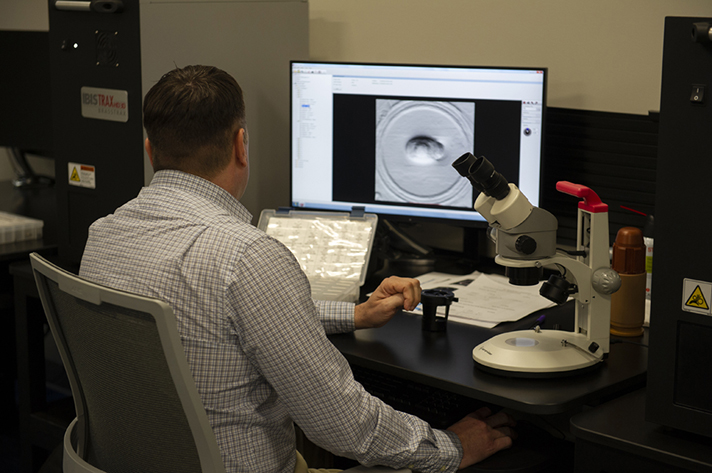
- Digital Imaging – ATF's Integrated Ballistic Identification System (IBIS) technology captures high-resolution images of the casings to identify unique markings.
- Casing Comparison – The unique markings are then compared in NIBIN to look for a match.
- Connecting Crimes – If investigators find a match, it can be used to uncover the history of a crime gun and connect it to other crimes and suspects.
Note: NIBIN is only used for criminal investigations and does not capture or store ballistic information acquired at the point of manufacture, importation or sale.
NIBIN in Action
Of the more than 1 million leads generated by NIBIN, here are a few examples of violent crimes solved with the technology:
- A federal jury convicted a man in South Carolina of illegally trafficking firearms. At least 13 times, he purchased firearms for personal use before then illegally transporting them to Maryland to sell. More than 30 firearms and ammunition found by law enforcement in the Baltimore area.
- A Baltimore gang member was sentenced to 38 years in federal prison for conspiring to participate in a violent racketeering enterprise known as the Black Guerilla Family ("BGF") gang, a nationwide gang which began operating in prisons. The defendant participated in the BGF criminal enterprise, including a murder and a drug distribution conspiracy; further, Warren was a “hit man” accepting money in exchange for murdering others.
- An armed drug trafficker was sentenced to more than 14 years in federal prison for drug distribution and firearm possession offenses. A NIBIN analysis of the firearm connected it to a shooting and a shots-fired incident earlier that same year.
- A gang leader and rapper in Missouri was sentenced to more than 6 years for illegally possessing firearms. A traffic stop led to the discovery of the firearms and a NIBIN analysis indicated one had been used in a recent drive-by shooting.